Google AI Overviews Now Being Tested in Ukraine: How It Affects SEO and What to Do About It

Some users in Ukraine have started seeing AI Overviews in Google’s search results. Promodo specialists were among the first to notice this. This is significant news for SEO experts, content marketers, and website owners, as it changes how information is presented and how clickable search results are in Google Search.
Here’s what’s known so far, how it may impact search visibility, and how businesses can prepare for the full rollout.
What Happened
- AI Overviews is a Google Search feature powered by artificial intelligence that generates brief summaries in response to users’ queries. These summaries appear directly in the search results, inside a dedicated block, along with links to the original sources of the information. It looks like this:
- There’s been no official announcement that this feature has launched in Ukraine. However, users with Ukrainian IP addresses are already seeing AI Overviews — both on desktop and mobile. Previously, this feature was not active in the region.
- According to Vladyslav Trishkin, SEO Team Lead at Promodo, Google appears to be testing AI Overviews not by query volume, but on a small group of users. This suggests the company is preparing for a wider rollout in the Ukrainian market.
- Brands are advised to prepare early to avoid losing search visibility. According to Similarweb data, clicks to websites drop when users get answers directly from AI Overviews.
How It Affects SEO
- Promodo points out that the experience in the U.S. showed noticeable changes in user behavior after the introduction of AI-generated overviews. On one hand, they improve convenience by quickly delivering answers. On the other hand, this new format has significantly disrupted organic search (SEO), e-commerce, and advertising.
- The hardest hit have been sites with informational content — blogs, news outlets, DIY guides, recipes, etc. This content is often used to generate AI answers, leaving users with little reason to visit the original site.
- Moreover, organic results are visually pushed much lower on the page. Research by Authoritas found that for e-commerce queries, the first traditional result now appears about 1,500 pixels down the page — more than a full screen scroll.
- For example, for a search like “best smartphone 2024,” users used to immediately see a list of links with reviews. With AI Overviews, a summary with top models and key specs appears at the top.
“Only after scrolling down will users reach regular results. Consequently, far fewer users reach organic listings — especially on mobile.”
The click-through rate (CTR) of the first organic result is on average ~34.5% lower compared to similar queries without AI answers.
- AI Overview doesn’t appear for direct commercial searches such as “buy sneakers”, as users are shown shopping ads and marketplace listings right away.
- However, top-of-the-funnel searches — like “best sneakers for kids” — are affected the same way as informational content, reducing traffic to e-commerce content such as reviews, comparisons, and brand blogs.
- American brands and online stores that invested in content marketing for organic traffic have already experienced a drop in leads and conversions due to this shift.
What You Should Do
Promodo offers several recommendations to help websites adapt and increase their chances of appearing in AI Overviews:
1. Structured Content
Present information in a compact, clear, and user-friendly format. Use:
- Lists
- Tables
- Short sentences and factual statements
- Proper heading structure
2. “How To” and Long-Tail Queries
Focus on how-to content and long-tail search queries. Analyze common user questions and provide clear, concise answers.
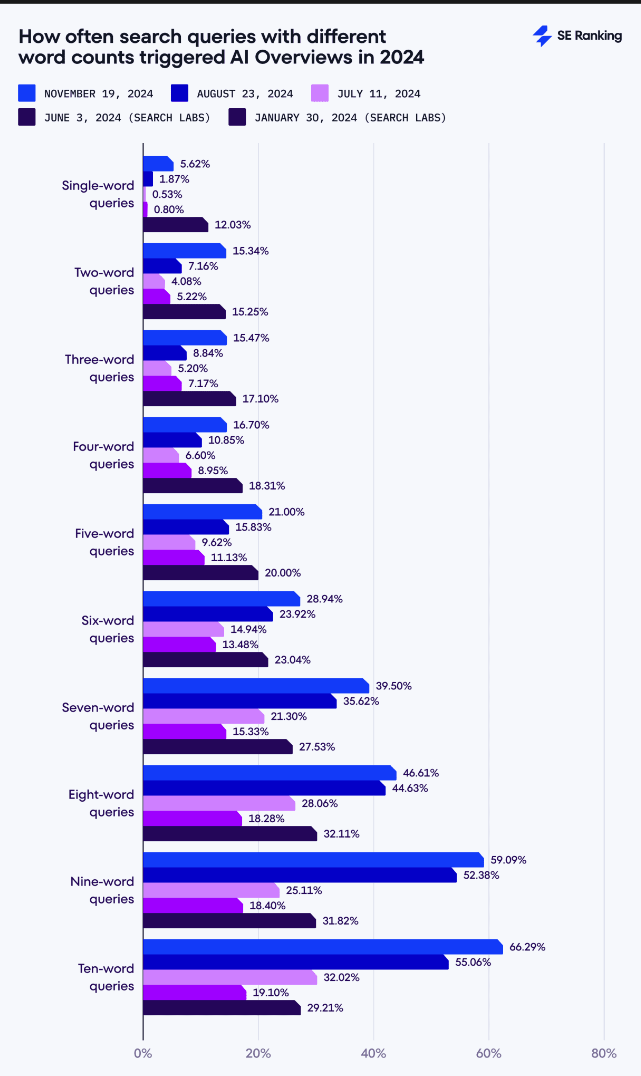
AI blocks appear in almost 60% of long-tail queries.
3. Schema Markup
Use structured data (microdata), especially FAQ schema, to enhance how your content appears in search results.
4. E-E-A-T Principles
Google emphasizes “people-first” content and values E-E-A-T, expecting content to come from trustworthy, expert sources. Use Google’s Search Quality Evaluator Guidelines to find weaknesses or areas to improve your domain or content pages.
- Promodo also recommends diversifying traffic sources — paying more attention to social media, email marketing, and direct traffic, rather than relying solely on search. They advise shifting the SEO focus to queries with commercial or local intent, where AI is less likely to intervene, as well as investing in unique content that sets your brand apart.
Don’t want to miss anything?
Subscribe to keep your fingers on the tech pulse. Get weekly updates on the newest stories, case studies and tips right in your mailbox.